Denali Solo Summit & Ski
Updated: Sep 29, 2025
Denali: The High One. Spring 2023, I set my sights on the largest peak in North America: Denali. The process to get here was a tedious one. From permits and travel logistics to gear and food, this expedition has been a constant effort for the last seven months.
In October of 2022, after coming back from Patagonia, I knew It was time to start planning another ski adventure for the upcoming spring. Originally my intention was to ski in the Yukon with a team but over the next two months, the vision evolved to a solo effort on Denali. As I progressed in the planning of this project I shared my vision with others and was constantly met with different reactions to my plan. While some were stoked on the idea, most gave crass and backhanded comments about the idea. Thankfully, the support I received for the project was from the most important people to me: my parents, close friends, accomplished mountain mentors, and colleagues at Alpenglow Expeditions. In hindsight, I should have kept these goals to myself to avoid any negative energy towards them.
As the winter in Tahoe provided some of the best powder skiing I have ever experienced, I was constantly thinking about getting back up to Alaska. Springtime couldn't come soon enough as every day seemed to get longer as the anticipation built.
During these months I spent my time planning the climb, acquiring gear, and training. Planning this trip wouldn't have been possible without Dan Koepke. He is a Team USA ice climber, mountaineer, guide, and mentor and has also climbed Denali solo. His guidance on gear, timing, acclimatization strategy, food and many other facets of the trip made my life much easier. With Dan’s guidance, I began training for this trip by pulling a sled on skis a few times a month, seeing how my body reacts to it along with practicing my sled-rigging systems. These days in conjunction with hours on the incline treadmill allowed me to go into this trip in decent shape to be pulling a heavy sled.
In early January I had to applied for a National Park Service’s Special Use Permit (SUP). This included a fee of $420, a climbing/skiing resume and a few questions regarding my itinerary. They ask about your timeline, training and experience, crevasse rescue skills and other emergency information. The answers to these questions rarely dictate if you'll receive the permit but are rather a time to ruminate on one's plan and its potential shortcomings. I took these questions seriously as it helped me evaluate my plans and their efficacy.
With my permit secured and my gear in order it was time to book flights and prep my gear.
I flew into Anchorage on the evening of May 21st and stayed one night at a motel. I bought my food the following morning at a local Wal-Mart and REI. I believe you can pre-buy your food at certain Fred Meyer locations to have it ready to go once you arrive. After getting my food dialed it was time to catch a bus up to Talkeetna.
After a two hour ride you'll arrive at the Talkeetna Alaskan Lodge. I got a room at the Talkeetna Inn that night and was able to get shuttled from the lodge to the motel. I checked into my shoebox of a room and went out for some food in downtown Talkeetna.
Here I met Jack and Zach as I recognized Jack from his FKT efforts on Shasta and Hood. The three of us hung out for a few hours at Denali Brewing and talked about our plans up on the mountain. After some food I made my way back to my room and prepped my bags for departure. While packing my food I did the math and had about 18 days of food with me. This slightly concerned me as I could be up there for a month but knew that I would be okay. The next morning (5/24/23) I had my meeting at the NPS Ranger Station which was only 300 feet from my motel room.
Myself along with Team KFC and System of Down were all briefed together. The meeting consists of a route overview, common issues encountered and of course the CMC’s. The Clean Mountain Cans are required on the mountain to minimize the impact of human waste on the environment. The meeting is straightforward: don't be dumb, climb safe, and try not to fall in a crevasse at 11k. Once we were set free from the park service, It was time to fly.
We all gathered our stuff and got to TAT. It was a classic hurry up and wait situation, which I was fine with. Just sitting around gave the trip even more suspense and allure. All the building of anticipation made taking off even better, even if it was the next day (5/25/23). That night most of the climbers spent the evening at the TAT bunkhouse which is a cabin they provide for free for climbers flying out. This was a cool experience to hear what brought others to the Alaska Range and what their plans were while in the range. After some good conversations it was time to try and sleep while the midnight sun raged on.
The next morning I was up early and eager to know if we would fly that day. I got to TAT and heard the good word that the skies were clear on the glacier and we’d fly today. Since I had moved up my flight a few days prior I was on the second round of planes onto the Kahiltna.
The flight itself is a beautifully scenic cruise at 10,000 feet through the park. Leanne was my pilot and is a gem of a human. We shared stories about our similar travel experiences in places we had both spent time in and she gave me words of encouragement for my solo trip. As we rounded One Shot Pass we skipped our way onto the glacier and came to a stop.
Unloading the plane might have been the most hectic part of the entire trip. You finally reach the glacier and want to get ripping towards camp one. All the anticipation is over and it's finally time. Well, before you go don't forget to grab fuel from Base Camp and rig the sled. Thankfully this process took me about 30 minutes and soon I was on my way down Heartbreak hill before I knew it.
Below: Landing at the airstrip

Out of the plane and onto the snow. A moment of suspension into a feeling of gratitude and gravity towards this immense goal I've already put so much effort towards. After months of preparation, gear talk and logistical planning: I was moving towards my goal. The first few minutes I was trying to remember how to ski downhill with my sled. The last time I skied a sled downhill I remembered just sitting on top of it. It was a fun process of sitting on the sled to gain speed, standing up to steer a little and continually bouncing between these two moves to control myself.
To move synchronically on a rope team with a sled full of gear is quite a difficult act as I observed as I skied down Heartbreak Hill. Thankfully, being solo and unroped, I was able to move quite well. At the base of Heartbreak Hill, the route meanders up the Kahiltna glacier to the north towards Kahiltna Pass. Between the base of Heartbreak hill and Camp One there were a few open crevasses but since the route is so well traveled, avoiding them on the ascent was as straightforward as glacial travel can be.
Below: Skinning away from Heartbreak Hill

I got to Camp One at 7,800’ in just over three hours, took an hour break or so, melted some water and ate a snack but ultimately decided to push further to make the next day’s move to 11k easier. After my break I pushed another 1,200’ to 9K Camp for the night. Zach and Jack from System of Down team joined me at the 9K camp as it was most conducive for their timeline as well. It was a complete whiteout from 7,800’ to 9K and I was relieved to set up camp for the night knowing I made a good call to push further.
Camp came together quickly at 9K and I joined Zach and Jack in their cook mid for a hasty meal of instant mashed potatoes. The experience up to this point still felt surreal. So many hours of planning and preparation had yet to leave my psyche and I still wasn't fully checked into the reality of being in the Alaska Range. The next day, 5/26/23, was a calm morning that inspired me to break down camp as fast as possible and get moving. The clarity in the skyline lasted for only fifteen minutes and as soon as I began moving I was in a complete whiteout, barely finding any depth in the terrain or the alleged wands marking the route.
Below: Packing my final items for day two

Moving in such a whiteout felt like a sensory deprivation exercise. I would not recommend solo glacial travel with conditions like this.
I felt extremely vulnerable on the glacier knowing that a massive trap-door of a snow bridge could collapse below me and I would likely fall to my demise.
After a few hours of this nauseating travel, I got to the unofficial camp at 9,800’ and my luck turned: a guided group was there retrieving their cache since they were camped at 11K Camp. This guided group wasn't in a great mood after hiking down in a whiteout and I didn't want to be around their negativity at all. I cut my break short and began working my way to 11k. Since that guided group had just come from 11K, the route was very well marked from here and I was beyond thankful for that. I cruised into 11k to be met with my first major campsite experience on Denali. I hated the seemingly endless sprawl of tents in such a fragile and delicate environment. Arriving at camp you can hear endless chatter about folks' gear, food, plans, acclimatization schedules, previous climbs and countless other mountain nonsense. I constructed camp in a newly vacant site so I could conserve as much energy as possible and shortly after took a well-deserved nap. Later that afternoon I wrote in my journal:
“ Stormy overnight- At least six inches of new snow but got blessed with some gorgeous views in the AM. Started moving in a complete whiteout. The morning views were just a teaser as conditions deteriorated and could barely find the trail wands to 9,800’. By far the scariest skiing I’ve ever done. Being on a glacier in a whiteout alone is terrifying. Now at 11k camp after a very snowing morning and afternoon “
After a quick meal of dehydrated chicken and rice, I'm off to bed for the night. I had been sleeping on and off catching up on rest and I’m unbelievably glad I did.
The next morning, 5/27/23, I woke up at 4 AM to a perfectly clear sky. I knew it was time to get up and go. Once again, I broke down camp as quickly as possible and I was off. I began breaking trail in the 12+ inches of new snow that had fallen in the last 24hrs. Although I knew it was going to be extremely difficult to break trail by myself with a sled, it was also going to be one of the few times I could be completely alone on this extremely packed route, and I reveled in that kind of experience. As I collected my things to head up Motorcycle Hill, the party next to me had the same idea. Max and Rae from Vancouver were also looking to seize the early morning clarity and were making their push up to 14K just behind me. We shared a few words before I clicked into my skis and started through some of the coldest, lightest snow I have ever moved through. I made a few switchbacks at the base of Motorcycle Hill along with some encouraging comments to Max and Rae who were within earshot. This area of the route is notorious not only for crevasses but for avalanche activity so my route finding had to be near perfection. As I slowed down after nearly an hour and a half of trail-breaking and Max and Rae gained more traction using my switchbacks, we began to talk a little more and got each other stoked!
Below: Motorcycle Hill with no tracks

I took a few more steps, then it happened. I am all of a sudden in a crevasse up to my hip on my left (uphill) leg with my right ski barely jammed in the lip to stop my fall. I immediately drop my hands down to the baskets on my poles and use them as improvised ice axes to arrest. Freaking out as my downhill ski is stuck between the snow lip and the crevasse supporting me, I find that my uphill ski has popped off from the pressure of the fall. Thankfully it was within an arm's reach. I grabbed my loose ski, put it uphill, and wiggled my lower ski free. In a compromised position, Max clipped my sled to himself for some added security as I figured out what to do. I was able to take my lower ski off while clinging to the ice. I then grabbed an ice screw and frantically spun it into the snow. Placing screws is much easier when you’re not halfway into falling down a bottomless pit unroped. I sunk the screw in and tethered myself to it.
Clawing my way up, Max was able to stay calm and supported me as I got out of this position. He grabbed my crampons from my sled, tossed them to me and I put them on. Rigging my skis to my pack and getting my spikes on was precarious. From here I collected myself and we moved further up Motorcycle Hill. I bowed my pride and suggested that Max and Rae create the track ahead of me so I knew what to expect and could spot the crevasses better. Due to the adrenaline and stress, we were flying uphill. We are about to crest the steepest roll at the top of Motorcycle Hill and again, another crevasse fall.
This time both my legs plunge simultaneously through the snow bridge and I shriek for help. By another stroke of luck, my 110L backpack with my skis in the A-frame configuration stopped me from heading down the abyss like a piece of rubbish flying down a city trash chute. I leaned back, rolled out of the hole, crawled my way downhill, and soon met up with them on the saddle that’s created by the top of Motorcycle Hill and Squirrel Hill.
Here I let out a few tears: thankful, grateful, humbled. All the emotions ran through me as I shared a warm embrace from Max. I had never been so vulnerable in the mountains and it seemed as if Denali was testing me, to see how far I was willing to push it that day. I wrote in my journal after the event at 14k camp:
“A moment of rumination and reflection: what the fuck am I doing here? Alone? No ropes? No partners? Breaking trail?
What am I trying to prove?
Everything was fine, until it wasn’t. Even reflecting on the previous day- I moved 2000 vertical and many miles in a complete whiteout: alone. At any second I could’ve fallen into a crevasse and that would’ve been the last of me.
At 11k, I listened to a book about a polar explorer who tried to cross Antarctica solo. He called for a rescue but soon died in a hospital in Chile from organ failure. He always said, quoting his mentor and idol- “better to be a live donkey than a dead lion”
Today's experiences embody this. Live to ski another day.
My approach to solo travel has changed: more conservative, and less aggressive. It’s one thing to ski a steep line by yourself. Another to fall into a crevasse and never be seen again.”
After reaching the top of Motorcycle Hill, Max, Rae and I decided to add me to their rope team until we reached 14K camp. I had a moment of reluctance as I knew this would compromise my pure solo style, but it was the obvious choice and I certainly will not die from hubris. We got roped together and methodically moved up Squirrel Hill while trying not to remind ourselves of the exposure to our left and the reality we’d meet if a fall wasn't arrested. We made light work of the section as our heavy sleds tried to pull us into the Peter Glacier thousands of feet below. The Polo Fields is the next section of the route which consists of a generally flat stretch that culminates in a short pitch before rounding into Windy Corner.

Left: Just above 11k camp before I got intimate with a crevasse
Below: Max, Rae & I roped up on the Polo Field

It was brutally cold here as we were still in the morning shade but major relief was felt once we hit Windy Corner and got into the sun. Oddly enough, we battled a decent headwind on the Polo Fields but had no wind once at Windy Corner. Max, Rae, and I felt a huge amount of gratitude for the strong sun and light winds as this can be a miserable section of the route.
With extremely calm conditions and gorgeous views, our rope team moved at a leisurely pace up to 14k Camp. There were a few suspect snow bridges just around the corner but after that it was smooth sailing into 14k Camp.
Below: Approaching windy corner as the Messner comes into view

As we meandered into 14k camp, Max and Rae snagged an amazing campsite with great windwalls right on the edge of camp. I just plopped down beside their site. All of the adrenaline and stress from falling in two holes truly caught up to me, so once I put my tent up I laid my foam sleeping pad in the sunshine and took an hour-long nap. It was amazing as the weather the last few days was anything but sunny and who knew how long it would last.
Below: The metropolis that is 14k Camp

The sunshine persisted all afternoon, a sight for sores. I cleaned up my campsite in the afternoon but did not build wind walls. My strategy was that due to the great weather we just encountered there would be a slew of parties descending down the mountain and vacating campsites.
Thankfully my first night at 14k was calm and the next morning, 5/28/23, I would move into a campsite with decent wind-walls. Before moving to my campsite, I took a short ski to see how I was acclimatizing. A short 500’ pitch right above camp was the perfect test. Making my first true downhill turns in the Alaska Range was a dream realized. All the snow and wind from the last few days made for awesome wind-packed powder. Still tired, I took my rest day very seriously and might have set a personal record for time spent in a sleeping bag.
The next few days looked quite similar to this: Sleep as late as possible, poke my head out to see if its clear, If so, go ski a short lap, If not; stay in the sleeping bag. This process persisted for roughly a week with an occasional deviation.
On day four at 14k camp I decided to ski the Rescue Gully. I left camp early to avoid crowds on the fixed lines, roughly 7:30 am. I ascended the fixed lines with only three other folks and was completely alone on the ridge between the fixed lines and 17k camp. This section of the route is the most picturesque. Looking to the Peters Glacier and Black Rock Peak will inspire any avid backcountry skier while climbing. Once you round the corner to see 17k camp, the entrance to the gully appears. It's a beautiful couloir, roughly a 200’ constriction, that opens up to a wide apron above 14k camp. Once I had my skis and bag into downhill mode, I skied gingerly to the entrance. I made conservative hop turns through the upper constriction and it was arduous.
Once the main crux was complete it was all about finding the line through the bergschrunds. This open powder field held great conditions for large GS-style turns. The Alaska factor is real up here. The size of this terrain is hard to conceptualize before you're in it. After a few arcing turns and catching my breath, I saw the clouds below me were moving in fast. Within a minute I was, once again, in the ping pong ball. I'm now constantly rehearsing my line mentally to avoid the large ‘schrund drops and the eerie sections of the blue ice above them. I would make about five to ten turns, stop to orient myself a little, and proceed once again. This took place for 4-5 minutes as visibility diminished. I soon was able to make out some climbers at the fixed lines and set my sights on them. In this pursuit of getting to my only visual que, I had to jump a small bergschrund with another small jump below it. These features back to back forced me to hold some speed which felt otherworldly in this visibility and setting. I arrived at the resting climbers and took a minute to recuperate with them.
The skiing back to camp from here is low angle and I’d skied it multiple times by now so the crevasses were very manageable. A major sigh of relief was had back at camp. After the clouds cleared later that afternoon I looked back up the pitch to see my track. I managed to nail the line around the bergschrunds & blue ice fairly well for whiteout conditions. Nathan skied it right after I did, he booted the line, and he encountered the same whiteout conditions I had. He was stoked to have a set of tracks to orient himself on his descent. Day four at 14k (5/31/23) would mark a week on the mountain and it felt great to have skied a line on the upper mountain.
Between the 1st and 3rd of June I rested at camp, waiting for a nice weather window. These days were mostly snowy with moderate winds at camp & roaring gusts up high. On the night of the 3rd, the NPS evening weather broadcast projected favorable conditions with increasing pressure for the next two. With this inspiring news I packed my bag and tried to get as much rest as possible.
June fourth I woke up at 7:15 am and immediately knew it was going to be a cold day. Although the sun has been up for more than two hours, the next few hours would still be in the shade. Earlier this year I had spent some time in Jackson Hole during one of their cold spells. We were touring in -30 temps and nothing compared to how cold I was on this particular morning. As I took off on my skis up towards the fixed lines, my body felt like it was moving in slow motion. I was so cold and continually had to convince myself that if I kept moving I would warm up. What I needed was another layer at this point. I found myself moving in short fast bursts to warm myself and while resting I would shake my legs and arms to get blood back into them. After a slow ascent from stopping and rewarming, I was at the fixed lines. At this point, I changed my skis for crampons and attached them to my pack.
A few days prior while skiing the Rescue Gully I used my largest mitts while on the lines and wished for more dexterity. I thought I would be able to get away with my next largest set of gloves. I started up the lines & was constantly shaking my extremities to get any feeling back. I kept moving up the lines for another few hundred feet and had to stop. I forced myself to two minutes of swinging my arms and had a terrible encounter with the screaming barfies. At this point, I couldn't feel my toes at all and knew it was time to head down.
I swung over to the descending line and moved downhill. I had such little dexterity that I opted for a prusik to control my descent. After a few minutes I was back at the base of the lines and began to transition back to skis. This time I transitioned even slower and still had no feeling in any of my toes. I finally was able to complete my transition and uneventfully skied back down to my tent. I immediately took my boots off and jumped into my sleeping bag, trying desperately to rewarm my feet. I would spend the afternoon recalculating for the next day’s summit attempt. I taped the toes on my ski boots and rubbed Dermatone on my toes, determined to make it work. Unfortunately, my hands and feet would only have a half day to recover before I would make another attempt as the weather would only hold for another day.
Below: roughly where I turned around due to the cold

Summit Day: June 5th, 2023. From self-debriefing my first summit attempt I knew I had to leave later in the morning to minimize cold exposure. Thankfully the day’s projected temps were roughly ten to fifteen degrees warmer across the mountain. I woke up around 7:15 and started out of my tent having some oatmeal and caffeine to start the day. Another morning being the first person on the route. Rebreaking the trail to the base of the fixed lines was another great experience on Denali. Experiencing this solitude on a heavily traveled route like the West Buttress is divine. The sun had begun to warm me right as I began up the fixed lines. On this day I was able to transition much faster and was comfortably warm, thankfully. I started the morning in my largest mitts to keep my hands warm but they soon became too much. I removed the liners which provided a happy medium for me. I kept them this way through the entirety of the fixed lines. The ridge above the fixed lines to 17K Camp was much windier this time around.
Large spindrift blowing up the mountain made for a beautiful experience while up there. Slowly making my way on the ridge, I wanted to put my liners back in my mitts. In the process of getting them out of my hoodie pocket I dropped one of them down towards the Peter’s Glacier. Concerned and frustrated, I made the call to continue onwards rather than downclimb roughly a thousand feet to retrieve my liner.
Below: Hanging at Washburn's Thumb (16,500')

I kept moving and was once again at 17k Camp. I made my way through camp and towards the base of the Autobahn, a section notorious for its fall hazard. I felt that it was a slightly overhyped section of the route in terms of exposure, or maybe I just caught it in good conditions. There was a well-defined boot pack with tons of fixed pickets for teams to utilize. The Autobahn was a generally uneventful traverse pitch that gets you to Denali Pass. Once at Denali Pass I took a nice break to rest.
I met a group of three from Bozeman and shared some of the sour candy I brought up. One of them was a monoskier and it was amazing to see somebody bring one all the way up here. On a clear day like this you are able to see the summit ridge while resting here at Zebra Rocks. I started my way up again. I felt slowed by the altitude. This was my first time above 17K ever.
I shuffled my feet to the Football Field at roughly 19,600’ over the next few hours. As I crested into this large flat section I saw Emmanuel, a friend from camp. We shared a moment of stoke as he was on his way down from the summit and I was less than a thousand feet away. After this exchange I saw the reality ahead of me: guided groups engulfed the entire route to the summit. This brought my pace to an absolute halt. The last pitch to the summit took me almost two hours. Although it was slightly frustrating I generally couldn't care less as my form of transportation down was fast. The summit ridge is another gorgeous piece of the route. What it may lack in technicality it makes up for in aesthetics. Up here I ran into Max and Rae which was another awesome experience to be able to share this moment with them.
Finally, I reached the summit of Denali. A calm and warm evening made hanging out at the top a delight.
Below: Standing on the summit of North America
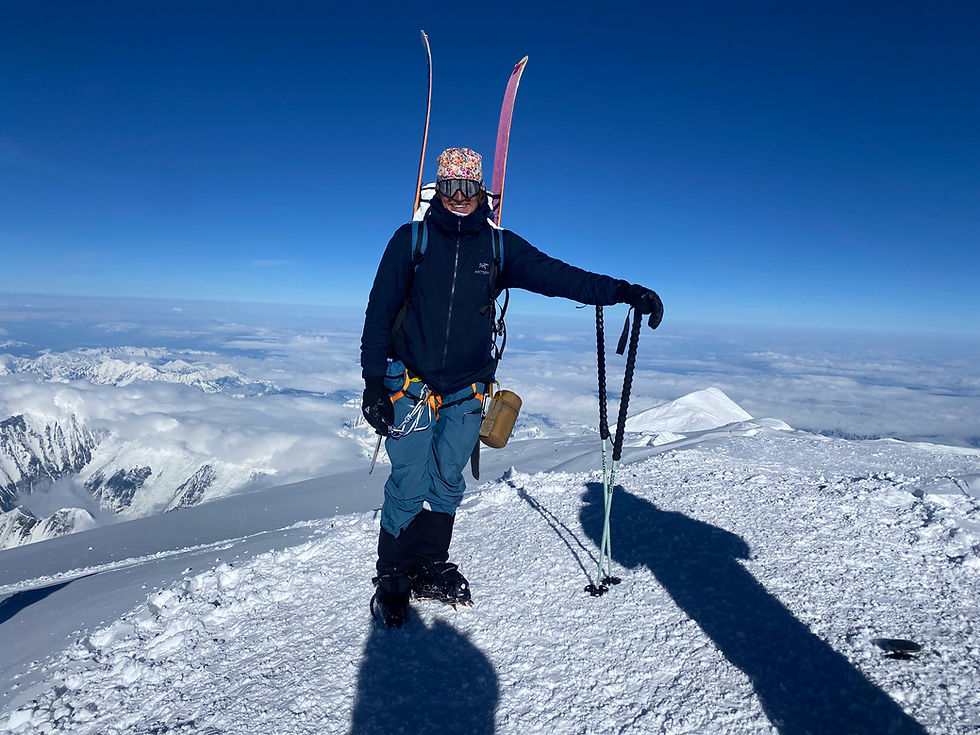
After taking a few photos for some guided groups and having them exchange the favor, I was on my way down. I clicked into my skis and knew I wanted to capture my descent all the way from the top. I strapped my GoPro on and began recording. As I moved to the summit marker to tap it with my skis I heard the dreadful beeps of the GoPro turning off. It captured me tapping my ski on the marker and that was it. A bummer to not have it on camera but that’s reality at 20,000’.
I started my way down the ridge adjacent to the boot-pack for roughly 100 feet then dropped skiers right towards the Football Field. The conditions consisted of packed powder and sharp wind lips. As I reached the Football Field I had thought of a grand idea.
I made a few more gingerly turns before I pointed it straight into the flats. According to my watch, I hit forty-one mph at 19,700’. That was before I started going uphill on the football field and was met with bulletproof, three foot high sastrugi. After successfully hopping one of these massive wind lips with too much speed, I landed on the uphill side on one of these lateral moguls. I immediately hit the wind-hardened snow with my entire body and one of my skis flew off. I began scolding myself immediately as I grimaced in pain on the snow, hoping I didn't destroy myself or my gear. A minute passes and I calm myself down, checking to see if my ice screw or ski edge cut me through my outerwear. Thankfully I came away with a mere bruise on my back and leg and nothing more serious.
A group of three were ascending towards Archdeacon's Tower and had witnessed my slam. They were nice enough to chat with me for a little while to make sure I was okay. I shamefully put my skins back on for the remaining short uphill for the day. Once here I removed my skins and began down once again, skiing very cautiously.
Now, taking short radius turns between 19,500’ and Denali Pass. This section of route is lower angle than the rest of the descent and held a variety of snow conditions that day. Once I reached Denali Pass I skied onto the Autobahn and my misfortune was yet to be over. As I crested onto the face and worked my way down next to the boot pack, my uphill ski pole caught a hidden picket from a prior season. It felt like somebody grabbed the bottom of my pole and yanked backward. This caused my pole to rip out of my hand and skip down into an open crevasse a few hundred feet below me. The force of the pole getting ripped from my hand spooked me knowing that if I had taken that same fall I would have also been in that crevasse.
Feeling off balance with just one pole I quickly tethered myself to a nearby picket, snagged my ice axe from my pack, and began down once again. The rest of the face was straightforward. Just a big traversing pitch on very firm snow. Once the exposure is done you'll end up skiing into 17K Camp. Here, I was enveloped in clouds. I had nervous thoughts about what my final piece of this ski descent would be like. As I passed camp Max and Rae said hello once again and wished me a safe descent. Thankfully I arrived at the entrance of the rescue gully in perfect evening sunlight.
Stoked I would be able to see my entire descent this time, I started making a few turns in the upper constriction. I took my time on this final pitch, soaking in the entire experience.
I will never forget the contrast of the shadowy snow on the ridge and the beaming rays of the evening sun just above 16,000 feet. Another moment of suspension, the illumination radiating into my soul, lifting my spirit and a devilish smirk to my face. Thankful for all the hard work this mountain had forced me to endure to received rewards like this.
I was tired and my main concern at this point was getting back to camp safe. I would make about ten turns, rest and scout the section below for the best (easiest) turns. Soon I was above the first bergschrund and skipped right over it. A few more turns and I found myself above the bottom, and largest, bergschrund. The sun had dipped below the west buttress a few minutes prior and the light became flat for this section. I had navigated myself slightly right of the tracks in the snow and found myself on the blue ice above the ‘schrund.
At this point, I only had one option and just like that I pointed em downhill and gapped the open hole. I land and can immediately feel the sun crust that I’m ripping through. I take a major sigh of relief. I’m thankful that the clouds parted for my descent in Rescue Gully and that I could take a moment to relax at the fixed lines. Here, skiing to camp was uneventful. I skied conservatively as the sun crust was much more developed below the fixed lines. One final crevasse crossing and I was cruising into camp.
Team KFC was standing on the edge of camp giving me hoots and hollers as I made my way down to them. They told me they saw me jump the final bergschrund and got hyped from their cook tent. They offered me some hot water and were just stoked to see me. While talking for a minute one of the boys from the Bozeman crew came over and told me that the sour candy I gave him at Denali Pass made his day. It made my day to think I stoked out some other climbers/skiers with a simple gesture like that. Our little congregation soon dispersed and we headed to our respective tents.
I dropped my bag outside my tent and walked down to Emannuel to let him know I was back in camp. I hung out in this cook tent for a little before it got too cold for me. Back in my sleeping bag and dinner consisted of some beef jerky and bars. That night I slept horribly due to the leftover adrenaline and the caffeine pill I took on the summit.
The next morning I tried to give away food at camp along with everybody else who had summited over the past two days. After a stroll around camp and a trip to the poop crevasse, I was ready to begin our trek down to base camp. I teamed up with Emmanuel for the lower section as he needed a partner and it made sense for me to rope up.
We had an epic day. Lots of faffing around with the sleds, falling in two more crevasses, and whiteout conditions. Once at 11K Emanuel dug up his cached skis and we rapidly increased our pace. Our plan while descending was to have Emmanuel pilot the sleds and I would be in the rear with the sleds between us, steering and braking when needed. This was a stellar execution compared to the difficulties we ran into above 11k. We took a break at camp one to put on our skins and began the final leg. It took us another two hours from camp one to base camp, arriving around 10:15 pm. We hastily put up our tents next to the airstrip and ate some food after another long day. As I crawled into my sleeping bag Emmanuel came to my tent with pre-cooked bacon and whiskey, a fantastic way to end a long day.
The next morning we eagerly got to the TAT tent to get our names on the flight list early. We left on the second plane that morning.
Below: Emmanuel out front with our sleds between us

This expedition seemed to fly by. The two weeks spent on Denali felt like a minute in comparison to the months leading up to it. This trip gave me an idea of what it's like to travel solo in big mountains. I believe there is great power when moving in teams. It gives us space to push beyond our perceived limits knowing we have a team with us, enduring the confronted conditions together. Being solo, we endure all the hardship and triumphs alone and must always play our own support role. Sometimes you want to be in the mountains alone and other times it’s great to have friends around to share moments with.


Comments